
Written by Peter, owner and lead technician at Trusted Garage Door Service in Logan, Utah.
Hinges are easy to overlook. They are small, they sit on the inside of the door and they rarely make noise until something is already wrong. But every time your door opens, those hinges let each section fold over the curve of the track. When one cracks, the stress moves into the door panels, and small problems turn into big ones.
Hinge replacement is one of the quick fixes we handle often as part of garage door repair in Logan, Utah. Here is what to look for and what to expect.
Key Takeaways
- Cracked hinges, loose or stripped screws and panels cracking near a hinge are the main warning signs.
- Hinges are numbered by position. Using the wrong number changes how the door sits in the track.
- A broken hinge can let the door bow, rub or come off its rollers.
- Bottom corner hardware is under cable tension and should only be handled by a pro.
What Garage Door Hinges Do
A sectional garage door is made of several horizontal panels joined by hinges. Center hinges join the panels in the middle of the door. End hinges on each side do double duty: they connect the panels and hold the roller stems that ride in the track.
Why Hinges Have Numbers
End hinges are usually stamped with a number. The number tells you where the hinge belongs, from the bottom of the door upward. Higher numbers hold the roller a little farther from the door, so each section clears the curve of the track as it opens. If a hinge is replaced with the wrong number, the door can bind, rub against the frame or sit unevenly.
Signs of a Broken or Failing Hinge
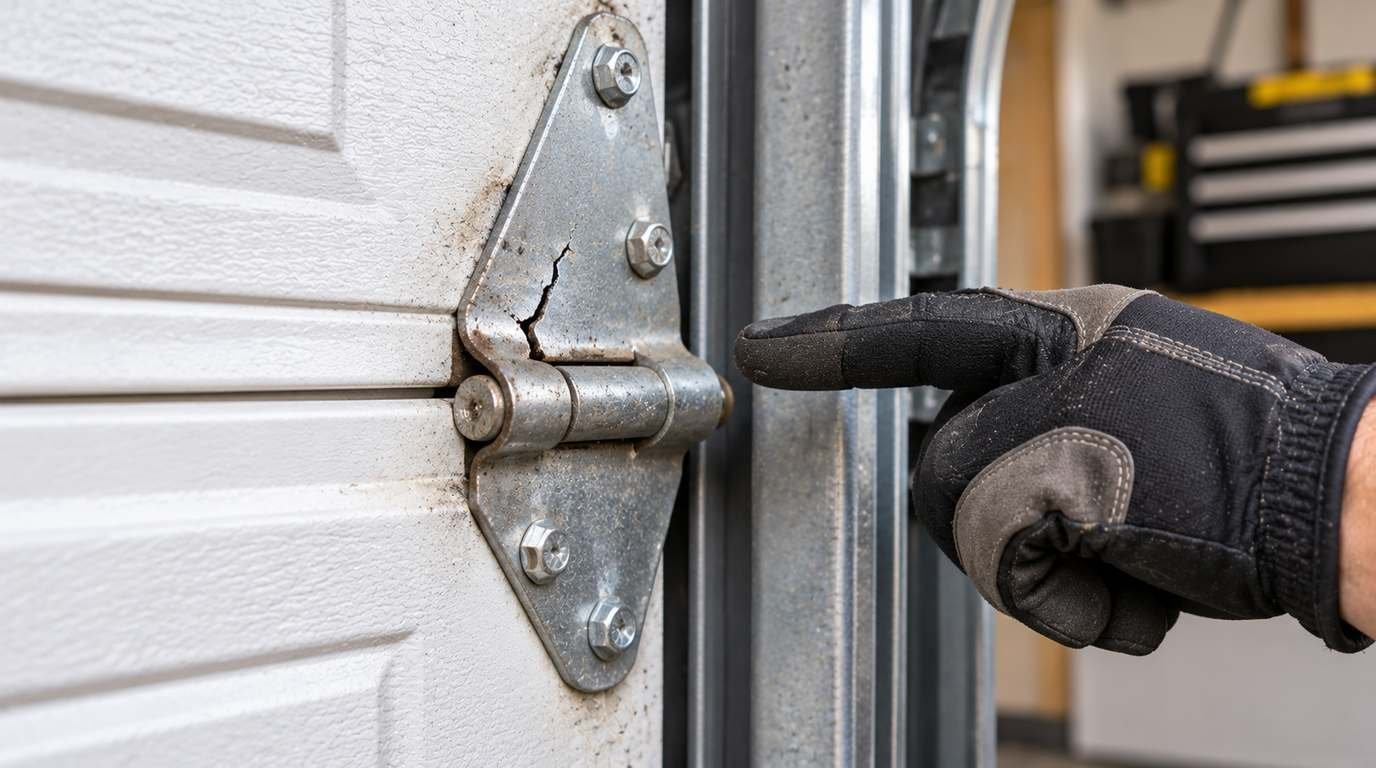
- A visible crack in the hinge leaf or a hinge that has split apart.
- Screws that are loose, missing or spinning in stripped holes.
- A panel that is cracked or bulging around the hinge.
- The door bows, sags in the middle or looks uneven when closed.
- Popping or creaking sounds as the door goes over the curve.
- A roller that tilts or no longer sits squarely in the track.
DASMA’s garage door checklist includes a visual check of hinges, brackets and fasteners for this reason. Loose or damaged hardware is often the first sign of a larger problem.
Why Garage Door Hinges Break
An Unbalanced Door
When springs weaken, the opener has to push and pull more weight. That extra force often shows up first as cracked hinges at the top of the door, where the opener arm connects.
Age and Metal Fatigue
Hinges flex thousands of times a year. Thin, builder-grade hinges eventually crack, especially on older doors.
Loose Screws and Stripped Holes
Vibration loosens screws over time. A loose hinge rocks back and forth, which tears the screw holes in the thin steel skin of the door.
Impact
A car bumper, a basketball or a door that jumped its track can bend or crack hinges in a moment.
Extra Weight
Heavy add-ons put more load on the hinges and the springs. DASMA’s guidance on adding weight to a door explains why changing the door’s weight affects the whole system.
Why Hinge Replacement Needs Care
Replacing a single center hinge on a closed door can be straightforward. The bottom corners are a different story. The bottom brackets hold the lift cables, which are under spring tension. Removing them can release that tension without warning. We also check that each replacement hinge has the correct number, that screw holes are solid and that the panel is not cracked.
Where screw holes are stripped, we may use reinforcement plates or a different fastener so the new hinge holds. If a panel is cracked around the hinge, we will tell you honestly whether it can be reinforced or needs replacing.
What a Hinge Repair Visit Includes
- Inspecting every hinge, not just the obvious broken one.
- Replacing cracked hinges with the correct number for each position.
- Tightening or repairing loose and stripped fasteners.
- Checking door balance, springs, cables and rollers, since an unbalanced door is often the root cause.
- Lubricating hinges and testing the opener and safety reverse.
Finding the root cause matters. If weak springs cracked the hinge, new hinges alone will crack again. That is why our garage door repairs always include a balance check, and why yearly garage door maintenance is the best prevention.
How to Spot Hinge Problems Early
You do not need tools to catch most hinge trouble. A two-minute look every month or two, with the door closed and the opener off, is enough.
- Shine a flashlight along each row of hinges and look for cracks, especially at the top section.
- Watch the door open and close. Panels should fold smoothly over the curve without popping or flexing.
- Listen for creaks and clicks that were not there before.
- Look for small piles of metal shavings or loose screws on the floor under the door.
- Check that every roller sits straight in the track.
Lubricate the hinge pivots with a garage door lubricant a few times a year, and never loosen hardware on the bottom section yourself. Our Logan garage door installation and repairs technicians can secure it safely.
Frequently Asked Questions
Can I keep using my garage door with a broken hinge?
It is not a good idea. A broken hinge lets the panels flex, which can crack the door or push a roller out of the track.
Do the numbers on garage door hinges matter?
Yes. The number sets how far the roller sits from the door at that position. The wrong number can make the door bind or sit crooked.
Why do my top hinges keep cracking?
Usually the door is out of balance or the opener arm is not reinforced, so the opener is pulling too hard on the top section.
The Bottom Line
A cracked hinge is a small part with big consequences. Catch it early, replace it with the right number and fix the reason it broke.
Contact Trusted Garage Door Service or call/text (435) 554-4962 for a free quote. If your panels are past saving, explore our garage doors. We serve Logan, Brigham City and Tremonton.